
Typical U.S. residential post-construction cleaning costs about $500 to $800, averaging near $650, or roughly $0.15 to $0.60 per square foot for interior work before add-ons. Your final price depends less on the floor plan alone than on what the crew must remove and how they'll remove it.
A room can look finished while fine dust remains inside cabinet hinges, along window tracks, and above door frames. That's why comparing post construction cleaning prices means comparing cleaning methods and written scope, not just the totals at the bottom of competing bids.
Post-Construction Cleaning Prices at a Glance
Use a square-footage rate to establish a budget, not to decide whether a quote is complete. The Pricer's post-construction cost guide places typical projects at $500 to $800, averaging about $650, with interior work generally running $0.15 to $0.60 per square foot and a 2,000-square-foot property costing approximately $300 to $1,200 before unusual disposal, specialty access, or exterior requirements.
The cleaning phase matters, too. Fixr's post-construction cleaning cost guide gives residential rough-cleaning rates of $0.15 to $0.40 per square foot and standard or final-cleaning rates of $0.20 to $0.60 per square foot.
Match the price to the scope
Post-construction cleaning price benchmarks for 2026
| Scope | Typical price | What it covers |
|---|---|---|
| Rough cleaning | $0.15 to $0.40 per sq ft | Large debris and heavy dust, with stickers and floor protection included only when specified |
| Final cleaning | $0.20 to $0.60 per sq ft | Floors, fixtures, windows, cabinets, and finished surfaces within the agreed scope |
| Touch-up cleaning | Confirm whether bundled with final cleaning or quoted separately | Dust trails and smudges before inspection or handover |
| Whole-job interior rate | $0.15 to $0.60 per sq ft | General interior budgeting benchmark, not an automatic allowance for every phase |
| Typical residential project | $500 to $800 total, average about $650 | A typical project benchmark, not a guaranteed price for every home |
| 2,000 sq ft home | $300 to $1,200 total | Before unusual disposal, access, or exterior add-ons |
| Crew labor illustration | Worker rate multiplied by crew size and time on site | Direct labor only, excluding materials, equipment, transport, and business overhead |
Don't add every row together. The phase rows describe different work, while the whole-job and property rows offer alternative ways to establish a starting budget. If a contractor separately prices rough and final cleaning, ask whether those charges replace or supplement the advertised interior rate.
A labor quote also needs a clear unit. Per worker per hour isn't the same as an hourly rate for the entire crew. Materials, equipment, travel, supervision, and disposal may sit outside direct labor, so a wage calculation won't necessarily reproduce the customer's invoice.
Read a starting price correctly
Glow Cleaning Company's Post-Construction Cleaning starts at $508. That's an entry price for the service, not a promise that every renovation has the same workload.
For budgeting, identify the required phase, measure the area being cleaned, and list anything beyond ordinary surface cleaning. Windows, remaining construction waste, difficult access, and stubborn residue deserve explicit treatment.
Budget rule: A price is useful only when you can describe what the crew will leave finished.
Two homes with matching floor plans can require very different amounts of hands-on work. A nearly dust-free handover and a house coated in cutting residue aren't comparable jobs.
What You Are Paying For in a Post-Construction Clean
Say your kitchen renovation is complete. The cabinets are installed, the counters look good, and the contractor has removed the tools. But opening a drawer reveals powder, the window track feels gritty, and protective film still clings to an appliance.
Post-construction cleaning removes dust and debris after renovations. It prepares finished surfaces for use, but it doesn't replace a contractor's punch list, hazardous-material assessment, or specialist remediation.
The distinction is easier to understand as a process.
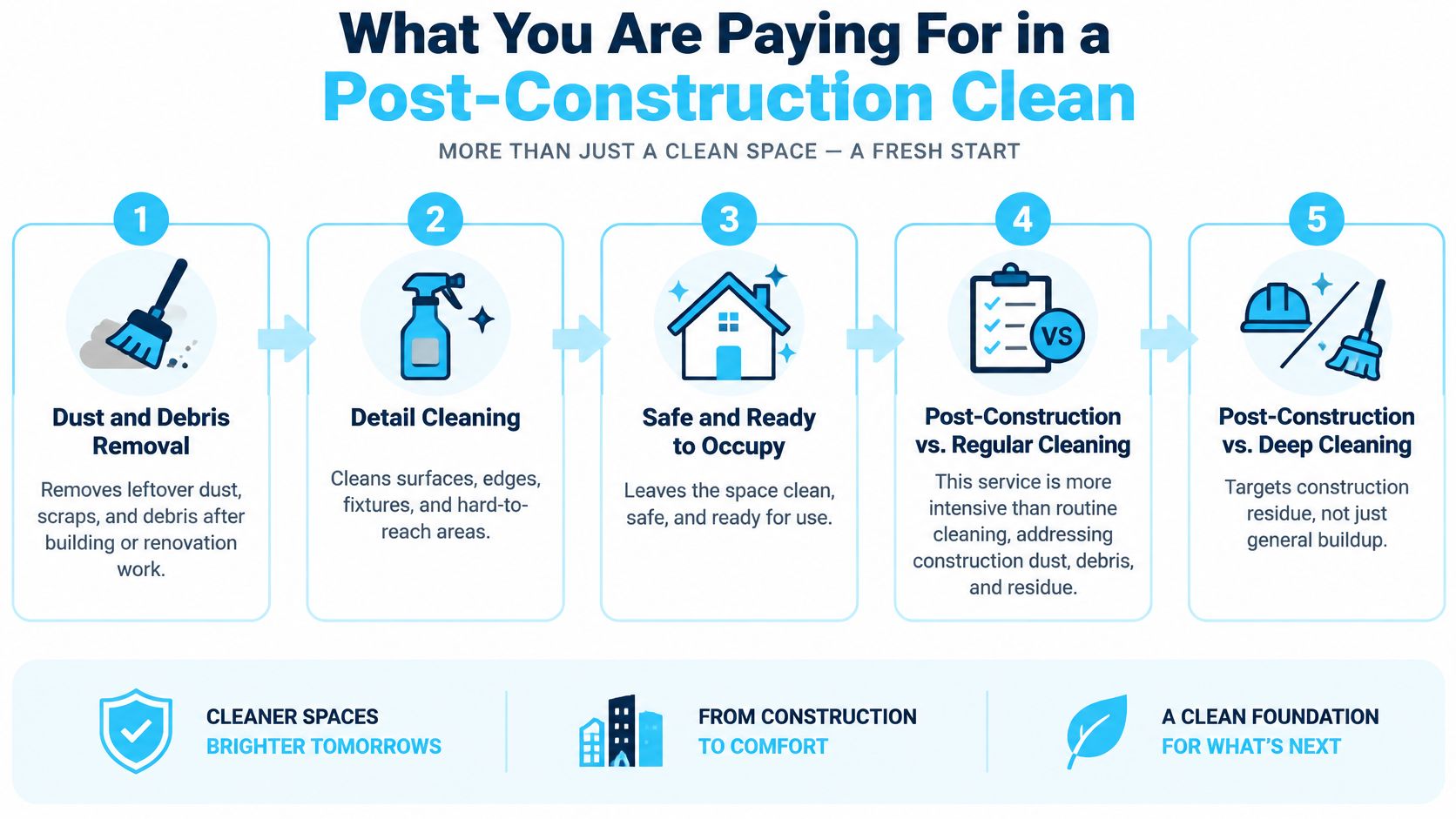
From construction site to usable rooms
Rough cleaning clears the obstacles to detailed work. That may include packaging, loose scraps, leftover materials, and agreed protective coverings. Don't assume the cleaner can distinguish rubbish from spare tile, warranty documents, or components the installer still needs. Set those items aside before work starts.
Final cleaning addresses the finished surfaces. Crews work from higher surfaces downward, capturing loose dust before damp wiping and finishing floors. Depending on the agreement, that can include cabinet shelving, fixture edges, interior glass, trim, and window tracks.
Touch-up cleaning handles the marks left between the detailed clean and handover. An inspector opens doors, a contractor adjusts hardware, or someone walks across a finished floor. Those activities can create a limited new cleaning task rather than evidence that the original clean was incomplete.
Why a deep clean isn't automatically the right booking
Regular cleaning maintains a lived-in home. Post-construction cleaning removes the residue of a workshop, including abrasive particles and deposits that need surface-specific treatment.
Our deep cleaning service addresses accumulated household dirt and less accessible areas. Construction residue requires a different scope, even when the property is otherwise empty and looks easy to clean.
A damp cloth dragged across loose grit can scratch a glossy finish. A scraper that works on one material can damage another. The crew needs to identify the surface, remove loose particles appropriately, and test any residue-removal method somewhere inconspicuous.
Before comparing providers, ask:
- Phases: Is this rough cleaning, final cleaning, touch-up work, or a combination?
- Finished condition: Which rooms and surfaces will be ready to use?
- Return visits: Is a later handover clean included or separately scheduled?
The question every provider must answer is simple: Exactly which cleaning phases does this quote include?
What Drives Post-Construction Cleaning Prices Up or Down
The biggest pricing mistake is treating every square foot as equally dirty. Size establishes the area, but residue, surface detail, and access determine how quickly a crew can finish it.
For silica-related work, OSHA's construction silica standard requires employers to use feasible alternatives to exposure-increasing dry sweeping, including wet methods or HEPA-filtered vacuuming. It also addresses exposure during contaminated-filter and protective-equipment disposal, which is another reason to separate ordinary rubbish handling from controlled dust removal.
The conditions that change labor time
Size and room count establish the starting workload. More floor area means more cleaning, but a divided layout adds doors, corners, trim, and fixtures. An open room can be faster to clean than a smaller collection of detailed bathrooms and closets.
Debris type changes the task. Bagged packaging is different from loose offcuts, and neither is the same as adhesive, paint splatter, or grout haze. Residue removal requires identification, testing, treatment, and inspection rather than a stronger cleaning product.
Dust migration increases detail work. Powder inside hinges, textured surfaces, tracks, and unfinished flooring takes longer to capture than dust resting on a smooth countertop. Cleaning accessible vent covers also isn't the same service as cleaning inside ductwork.
The phase count affects mobilization. A crew that must unload, prepare equipment, clean, and pack up on separate visits has more work than a crew completing an uninterrupted final clean.
Logistics and extras deserve their own lines
Site readiness can outweigh the apparent simplicity of a room. If installers still need the space, cleaners may have to work around them or leave finished areas exposed to new contamination.
Other conditions deserve explicit pricing:
- Access: Stairwells, elevator reservations, distant parking, and restricted loading areas consume paid crew time.
- Commercial coordination: Phased handovers, building rules, and after-hours access change scheduling and supervision.
- Specialty tasks: Appliance interiors, carpet extraction, exterior glass, and restorative floor work shouldn't be assumed.
- Waste removal: Carrying debris to an on-site container is different from transporting it away.
Don't let a broad label such as complete cleanup conceal these distinctions. Ask for a boundary between surface cleaning, residue removal, and hauling.
A useful model is base mobilization + estimated labor + clearly identified additions. Those additions might cover high-dust surfaces, cabinet interiors, window tracks, adhesive removal, lifts, or debris volume.
Keep cleaning labor and hauling separate even if the same business supplies both. That makes it easier to remove an unnecessary service, assign waste removal to the contractor, or understand why a commercial quote is higher.
Real-World Price Examples by Project Size
Commercial figures can make a residential quote look suspiciously cheap, while residential rates can make a commercial project look overpriced. Neither comparison helps unless the jobs involve similar phases, conditions, and handover requirements.
CleanerHQ's construction-cleanup pricing overview places a 2,000 to 3,000-square-foot home or small office around $500 to $1,500, a typical contract near $7,300, and a 20,000-square-foot commercial project around $8,000 to $25,000 or more. These are different project categories, not interchangeable prices for the same service. The mid-range contract figure is priced on scope rather than a standard size band, so it doesn't translate into a per-foot rate you can apply to your own building.
Compare project types without confusing the scope
Post-construction cleaning cost by project size
| Project | Size | Typical total | Why it lands here |
|---|---|---|---|
| Residential remodel | Renovated rooms plus adjoining areas the dust reached | Glow Cleaning Company flat rates start at $508 | Fine dust migrates beyond the construction footprint |
| Home or small office | 2,000 to 3,000 sq ft | Approximately $500 to $1,500 | Residential-scale work with a defined cleaning scope |
| Large commercial project | 20,000 sq ft | Approximately $8,000 to $25,000 or more | Greater scale, access requirements, phases, and debris handling |
The bottom of the residential bracket is a real service level, not a teaser rate. Glow Cleaning Company prices post-construction cleaning as a flat rate starting at $508, with the exact total shown in the instant quote tool before booking and no surprise fees added later.
The missing information in a price example matters as much as the number. A quote that includes interior glass and cabinet interiors can't be judged against one that only covers exposed surfaces. Square footage alone says nothing about method either: a HEPA-filtered final clean over detailed surfaces is a different job from a sweep of visible debris, so two quotes for the same footprint can legitimately sit far apart.
Likewise, a total for a small renovation may cover affected adjoining rooms, not just the newly built space. Tell the estimator where workers travelled, where materials were cut, and whether doors remained open during sanding.
Work through the quote rather than chasing a midpoint
Say you're budgeting for an empty renovated home. Start by marking the rooms that need cleaning, then identify the required phase and any separately priced detail work. I'd rather see one detailed quote at the top of a range than three vague quotes at the bottom.
Next, check whether the proposed floor-area rate covers the whole agreed job or only a particular pass. If rough and final cleaning are separately charged, calculate each against its own scope instead of assuming the advertised whole-job rate includes both.
For a commercial handover, add the operational questions: Can the crew reach every room in one mobilization? Will fixtures or millwork arrive after the floors are cleaned? Each "no" adds a return visit or a scope gap that the range midpoint won't warn you about.
Use the range that matches the work you need, not the lowest number attached to a vaguely similar building.
If the renovation coincides with a property transition, distinguish construction cleanup from move-in and move-out cleaning. Empty rooms make access easier, but they don't remove construction residue.
Choose the closest project category, allow for the full relevant range, and use photos or a walkthrough to replace assumptions with a defined scope.
Why the Cheapest Quote Can Cost You More
The cheapest bid can represent less work, not better value. A crew removing visible scraps and wiping exposed counters isn't doing the same job as a crew controlling fine dust across detailed surfaces.
Compare the proposed method alongside the price.
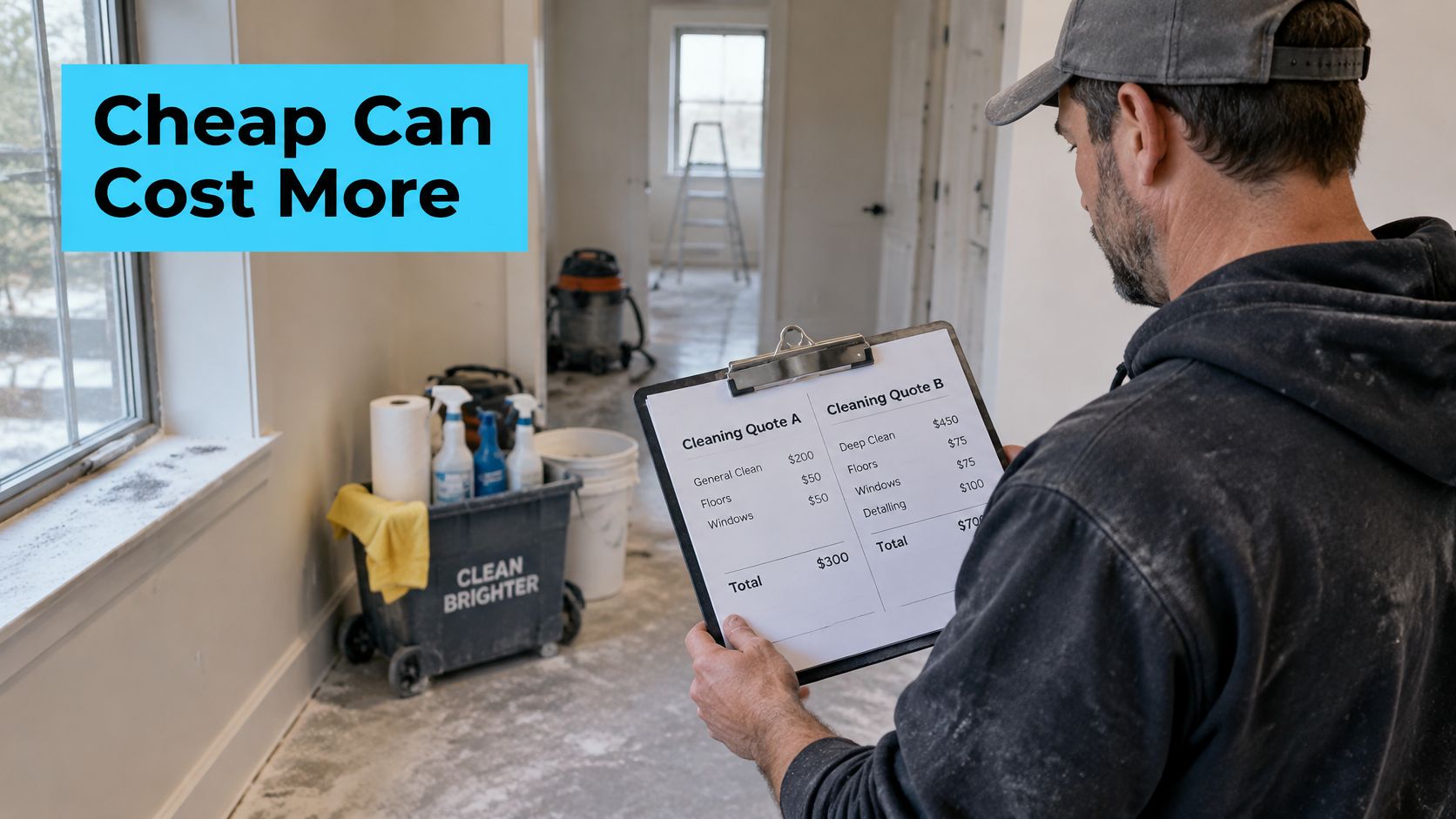
Dust type determines the appropriate method
Cutting and grinding silica-containing materials, including concrete, masonry, and engineered stone, can generate respirable crystalline silica. OSHA's construction silica guidance sets a permissible exposure limit of 50 micrograms per cubic meter as an eight-hour time-weighted average and requires a written exposure-control plan for covered work.
That's a worker-exposure standard, not a household cleanliness score or a guarantee that a finished room is safe to occupy. You can't assess airborne exposure by looking at a shiny floor.
The OSHA silica construction FAQs explain restrictions on exposure-increasing dry sweeping, dry brushing, and compressed-air cleaning, with wet methods and HEPA-filtered vacuuming used where feasible. A household vacuum shouldn't be assumed suitable just because it can pick up visible powder.
The added work may include controlled access, careful extraction, damp wiping, repeated inspection, and appropriate handling of contaminated equipment and waste. A premium isn't justified merely because someone writes HEPA on a quote. The provider should connect the equipment and procedures to the actual work.
Separate necessary protection from unnecessary upselling
Ask the deciding question directly:
Does this quote include appropriate dust control for the materials disturbed, or only visible debris removal?
Then ask how the cleaner knows which materials were cut or ground. If nobody has asked about the renovation, a confident promise of complete dust removal deserves scrutiny.
This comparison is about the work being purchased.
After tile, stone, concrete, or masonry work, I would prioritize a documented dust-control method over a bargain headline price. If dust entered operating HVAC equipment, identify whether a separate HVAC assessment is needed rather than assuming surface cleaning covers the system.
A paint-only refresh with minimal preparation and little residue may need a lighter final clean. Children or pets are another reason to plan access carefully, but the materials disturbed and site conditions should determine the method.
Don't pay for an elaborate package without a reason. Don't accept an unsuitable shortcut because the room looks clean.
How to Get an Accurate Post-Construction Cleaning Quote
An accurate quote starts with an accurate description of the site. A finished-looking room can still contain enough hidden residue or unfinished work to make a phone estimate unreliable.
The Calm Roost's post-construction pricing guide describes a 1,600-square-foot remodel receiving quotes from $360 to $825 and reports an overall median of $614 across 98 cleans. Those figures illustrate why floor area alone doesn't establish a comparable scope.
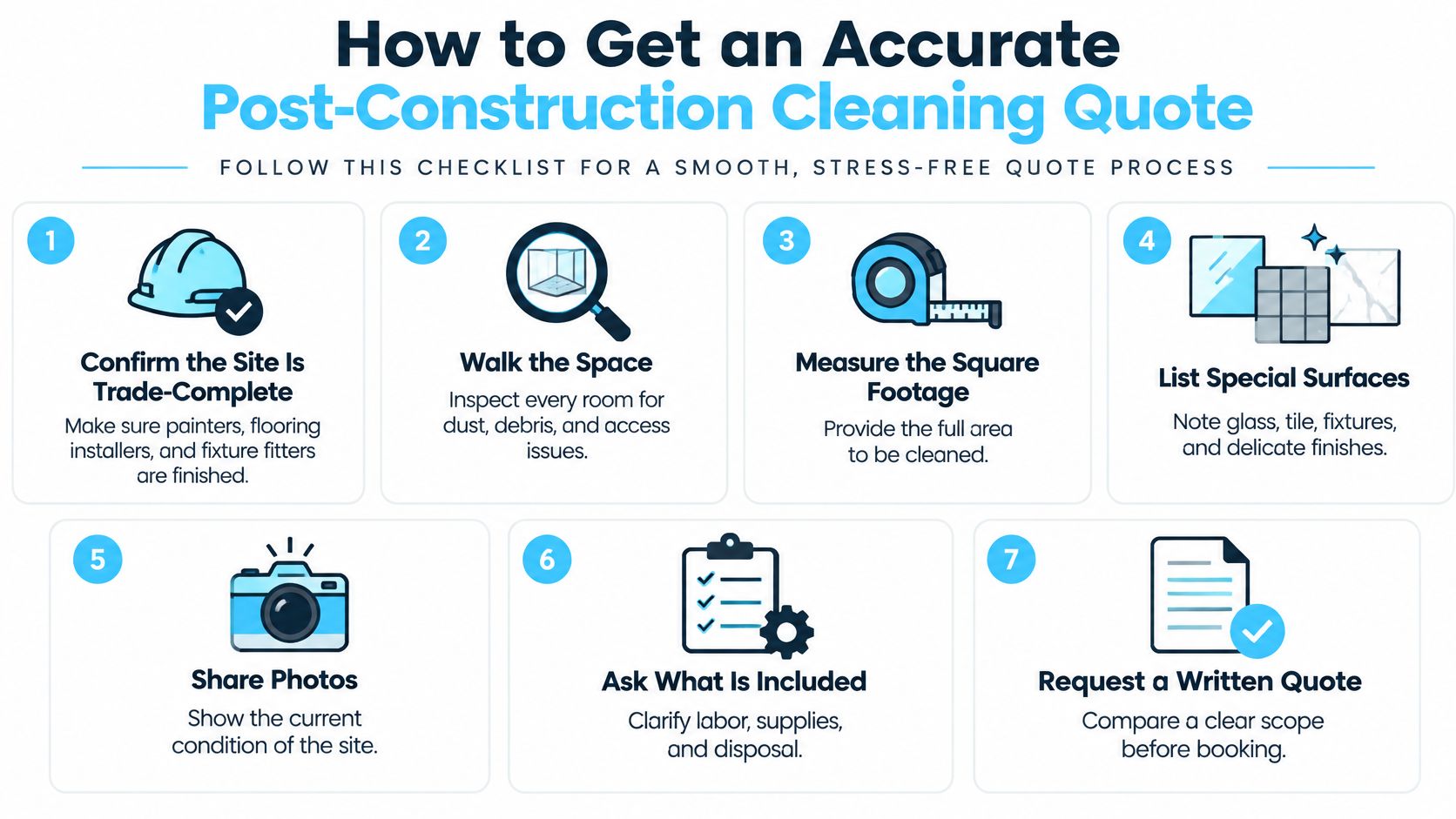
Use this checklist before choosing a booking date.
Give the estimator information they can price
1. Confirm the site is trade-complete. Painters, flooring installers, and fixture fitters should have finished the work that will affect cleaned surfaces. If they're returning, describe what remains rather than calling the site ready.
2. Inventory the cleaning area. Include square footage, room layout, stairs, glass, cabinets, appliances, and accessible vents. Separate interior work from exterior requests.
3. Photograph the worst areas. Send clear close-ups of tracks, dusty shelves, residue, and floor edges, plus wider room views. An attractive photograph from the doorway won't show the work that takes longest.
4. Name the required phases. Specify whether you need debris clearance, detailed final cleaning, or a later touch-up. Confirm whether windows and cabinet or appliance interiors belong in the selected scope.
5. Assign responsibility for debris. State what the contractor will remove and what remains for the cleaner. Include where waste must go and whether off-site hauling is required.
6. Describe the dust-producing work. Identify cutting, grinding, sanding, and the materials involved. Request the corresponding cleaning method, not just a promise to remove dust.
7. Keep the agreed price and scope together. Save the task list, selected additions, exclusions, and booking confirmation. Our instant quote tool shows the exact flat-rate price before booking, with no surprise fees or hidden surcharges, so the price shown is the price paid.
Flag residue before it becomes a scope dispute
Grout haze, cement residue, adhesive, stickers, and paint overspray aren't interchangeable cleaning tasks. They can require compatible products, controlled dwell time, gentle removal tools, and a test on an inconspicuous area.
Cabinet interiors add shelf, hinge, drawer, and edge work. Heavy adhesive adds individual treatment; overspray adds careful surface-by-surface removal. There isn't a defensible universal surcharge for these conditions without knowing the material, extent, and finish.
Disclose them before booking. With any provider, newly discovered or newly requested work should be discussed and authorized, not converted into an unexplained charge after cleaning.
Compare Quotes and Book With Confidence
Book the quote that completely addresses your needs, not automatically the lowest number. A complete quote doesn't mean buying every possible service. It means knowing which work is necessary, which work is excluded, and who is responsible for the remainder.
Read competing bids side by side. If one includes detailed interiors and another doesn't, ask for matching scopes before making a price judgment. A short written clarification can prevent a much longer dispute at handover.
Make the comparison practical
Check the following before approving the job:
- Completion standard: Identify the rooms, surfaces, and phases included.
- Dust method: Match the proposed process to the materials disturbed.
- Waste boundary: Confirm who removes scraps, bagged debris, and bulky leftovers.
- Accountability: Verify insurance, bonding where relevant, exclusions, and the agreed price.
- Timing: Establish whether a later visit is part of the booking or a separate service.
Glow Cleaning Company offers Post-Construction Cleaning from $508 in Fall River. Households and property managers in Taunton, Attleboro, New Bedford, Dartmouth, and nearby Rhode Island communities can check availability for their address and review our cleaning packages when choosing the right service.
Outside our service area, use the same comparison process with local providers. A well-defined scope remains useful regardless of local wage levels or building type.
Protect the finished result
Schedule final cleaning after dust-producing work has ended and before furniture blocks access to floors, walls, and cabinetry. If an inspection or walkthrough will happen later, decide whether a touch-up visit is needed rather than leaving that responsibility unsettled.
Before the crew arrives, secure spare materials, identify delicate finishes, and make sure the agreed areas are accessible. Those simple preparations let the cleaners spend their time cleaning rather than resolving avoidable questions.
---
Glow Cleaning Company offers post-construction cleaning to remove renovation dust and debris, with an exact flat-rate price shown before booking. Visit Glow Cleaning Company to select your service and property details, or call (508) 296-6633 to schedule a cleaning and discuss the work your renovation needs.