
You've got the keys in one hand and a truck on the calendar. The rooms look empty, but the counters still have a film, the baseboards are gray, and nobody has agreed what "clean" means before the walk-through.
A move in cleaning service is a defined turnover standard, not a vague promise to make the place look nicer. It has a room-by-room scope, tasks that cost extra, a price that moves with size and condition, and a separate path when renovation dust is involved. Write those pieces down and you can request the right clean instead of arguing about missed spots on move-in day.
What a Move-In Clean Covers Room by Room
Start with the map. Every area has a standard inclusion and a task that is usually priced apart from it.
| Area | Included | Usually Extra |
|---|---|---|
| Kitchen | Cabinet fronts, sink, counters, backsplash, appliance exteriors | Oven and refrigerator interiors |
| Bathrooms | Toilet, tub or shower, sink, mirrors, spot grout cleaning | Mold removal, re-grouting |
| Floors | Vacuum and mop hard floors, baseboards, door frames | Carpet shampooing |
| Walls and fixtures | Ceiling fans, light fixtures, switch plates, door handles | Paint touch-ups, wall repair |
| Windows | Interior glass and sills | Exterior windows and screens |
| Closets and storage | Interior shelves, rods and doors wiped | Junk removal |
Move In/Out Cleaning leaves a new home move-in ready or a property spotless for the next tenant. We arrive fully equipped with commercial-grade vacuums, fresh microfiber mop heads, and safe sanitizing supplies, so you don't supply equipment or chemicals.
How high-touch points are cleaned
Door handles, light switches, faucets, toilet handles, countertops, and appliance handles get soap or detergent and water first. The CDC cleaning guidance says visibly dirty hard, non-porous surfaces should be cleaned that way because organic soil can interfere with a disinfectant.
Only after that residue is gone does an EPA-registered disinfectant go on, at the concentration printed on the label, and stay visibly wet for the full contact time. Wiping it dry early can reduce the kill. A written note of the product name, the surface, how it was applied, and the required wet time is the record that matters. A general claim that the unit was "sanitized" doesn't say what was used or whether it stayed wet long enough.
Touchscreens and control panels are a separate case. Wipe them with a compatible product and don't saturate them. A soaked panel is a repair, not a clean.
Practical rule: Detergent first, disinfectant second, and only on the surfaces the label allows. If the wet time isn't written down, you don't have a disinfection record.
What is not in the clean
Three exclusions cause most arguments between tenants, landlords, and cleaners.
- Paint touch-ups: Scuffs and nail holes stay on the wall. Cleaning removes soil, not the need for paint.
- Wall repair: Holes, loose drywall, and cracked trim are maintenance. They don't come out with a cloth.
- Pest treatment: Visible droppings can be wiped. Treating an infestation belongs to a pest company.
Junk removal is its own service. If closets still hold boxes, broken furniture, or bagged trash, request it before the crew arrives. Shelves can't be wiped while they're full, and hauling isn't folded into the turnover price.
What Changes the Price of a Move-In Clean
Each starting price is the floor of a tier. Your quote moves inside that tier, or into the next one, once size and condition are known.
| Service | Starting Price | Typical Use |
|---|---|---|
| General Cleaning | $150 | Routine upkeep of an occupied home |
| Deep Cleaning | $425 | Built-up grime behind furniture and on baseboards |
| Move In/Out Cleaning | $480 | Empty unit turnover for a new occupant |
| Post-Construction Cleaning | $508 | Renovation dust and debris in Fall River |
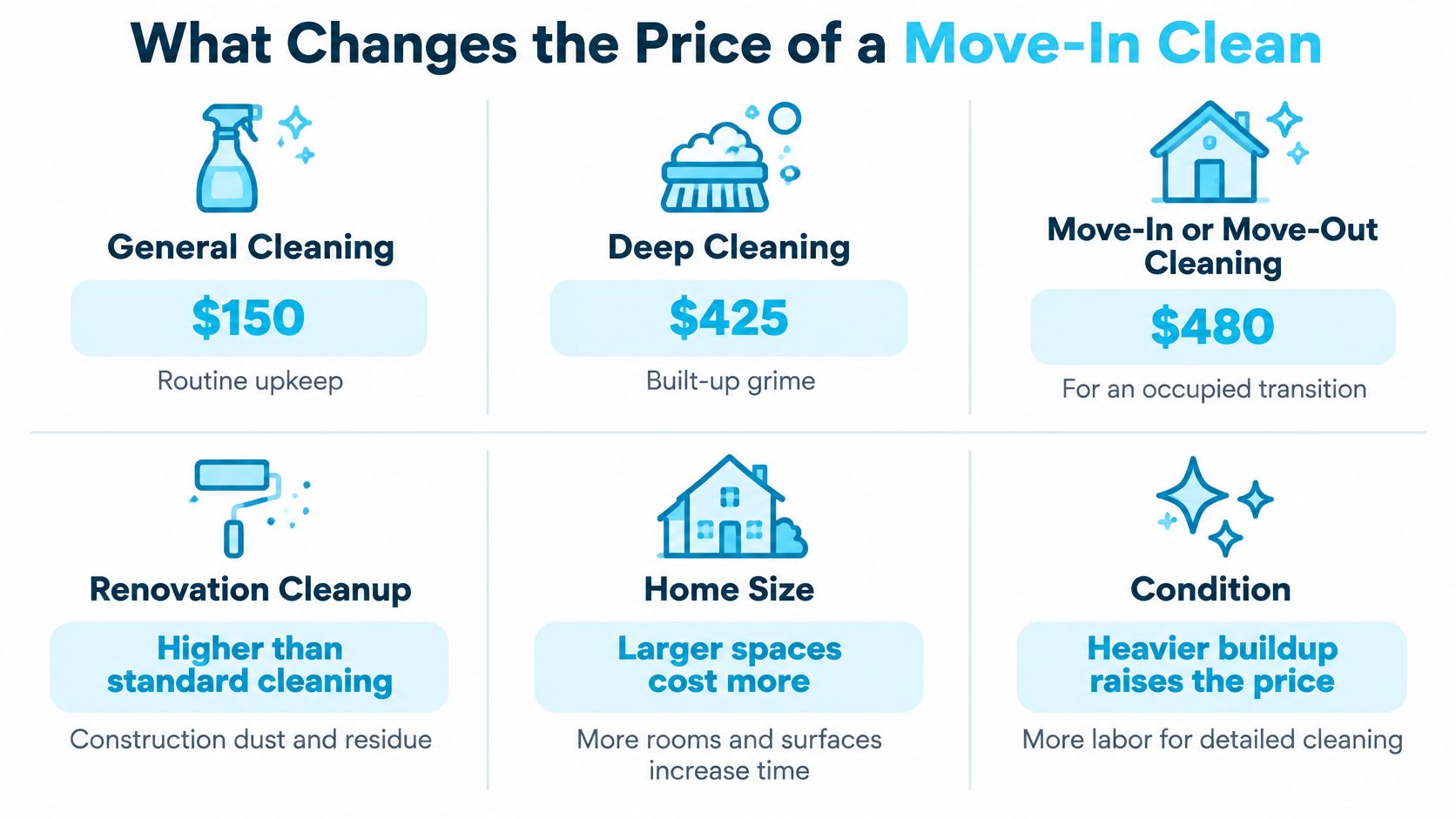
Pricing is flat-rate with no surprise fees or hidden surcharges, so the price shown is the price paid. The number still depends on what you ask the crew to clean.
What moves a quote inside the tier
Three inputs do most of the work. Square footage sets how much floor, trim, and wall the crew covers. Bedroom and bathroom count adds fixtures, and bathrooms take longer than bedrooms of the same size. Condition is the labor nobody sees in the listing photos. Kitchen grease, bathroom limescale, and pet hair each add passes that a lightly used unit doesn't need.
Say you're turning an empty one-bedroom apartment with one bathroom. Counters, one bath, and open floors are a straightforward turnover, and the starting move-in price is the right neighborhood if the unit isn't coated in grease. A furnished four-bedroom house with two bathrooms is a different job. Furniture has to be worked around, two baths double the fixtures, and baseboards hide hair and dust the photos don't show. That house can land nearer the cost of a deep cleaning than a light turnover if grime has built up behind furniture.
Add-ons sit on top of the base. Oven and refrigerator interiors and interior windows are the ones people forget to name. Building access matters too. A walk-up with several flights, or an elevator that has to be booked, changes how long the crew is on site.
Cleaning is not maintenance
A 2026 rental-owner report from Hemlane found tenant turnover was the leading challenge for 42% of surveyed owners, and renters increasingly expect cleaner move-ins. Speed cuts both ways here. An incomplete clean can delay leasing or force a second visit, and stuffing repairs into one price creates a fight when the invoice arrives.
A turnover quote is built from square footage and bathroom count, with add-ons such as refrigerator and oven interiors listed separately. Painting, repair, pest treatment, and junk removal stay outside the cleaning price. A written scope and a room-by-room checklist confirm what will be cleaned before the next tenant receives the keys.
Compare two quotes only when both list the same square footage, bathroom count, add-ons, and whether high-touch disinfection is included. A lower number that drops those items isn't a like-for-like price.
When to Book a Move-In Clean Around Your Move
Book against the empty window, not the day the truck arrives. The clean needs a bare unit and a little slack in the calendar, and both disappear fast once a move is underway.
| Timing | Action | Why It Matters |
|---|---|---|
| 2 to 3 weeks before move-in | Book a flat-rate slot and confirm the scope | Popular dates fill, and the quote is fixed before you move |
| Move-out day, after furniture leaves | Schedule the clean for the empty unit | Empty rooms are faster to clean and show every mark |
| After renovation, before furniture | Book post-construction cleaning first | Dust settles before fixtures and furniture are installed |
| 1 to 2 days before move-in | Confirm water, power and access | Technicians need working utilities and keys or codes |
| Before the final inspection | Finish the clean at least a day before | Surfaces dry and dust settles before the walk-through |
| Day before key handover | Walk the finished unit and flag missed spots | The rooms are still empty, so touch-ups stay quick |
The clean follows move-out and furniture removal. Empty rooms show every marked wall and dusty corner, and the work should finish before the new occupant arrives. The U.S. Census Bureau's 2024 five-year American Community Survey recorded roughly 19.7 million people who moved within the same county, and renters accounted for about 11.8 million of those same-county movers. Each of those moves creates the same short gap this section is about: one household out, the next one in, and a unit that has to be reset in between.
Who should book, and for which home
- Renters book a move-in clean before the lease starts, while cabinets and closets are still empty.
- Landlords book the turnover between tenants, after the old furniture is out and before photos or a showing.
- Homeowners book when they take a purchased or renovated house, before their own furniture lands on dusty floors.
If sanding, drywall, flooring, or painting happened after the last tenant left, book post-construction cleaning before any furniture arrives. Dust that settles on a new sofa is much harder to lift than dust on a bare floor.
Access that actually delays the day
A reserved date still slips if the crew can't work. The crew brings its own equipment and supplies, so your side of the list is short: working water and power, keys or an access code, and a clear path into every room. A locked utility closet or a fridge still full of food stops the tasks those areas require.
Count backward from the listing date
If the unit must be leased by a fixed day, don't book the clean for that morning. Finish the clean one day early so surfaces can dry, then hold one spare day for a re-clean.
A unit listed on the 15th should have its clean finished by the 12th. The 13th is the settle day before the walk-through, and the 14th is the spare day if something was missed. The buffer works like a hotel's gap between checkout and the next guest: the room has to be ready before anyone is standing at the desk. Booking the 15th itself leaves no room to dry, recheck, or fix a room.
Why Renovation Residue Needs a Different Clean
A unit can look clean after renovation and still hold fine dust. Visibly clean doesn't mean ready for occupancy, because construction dust can stay in the air or get pushed back through the ducts.
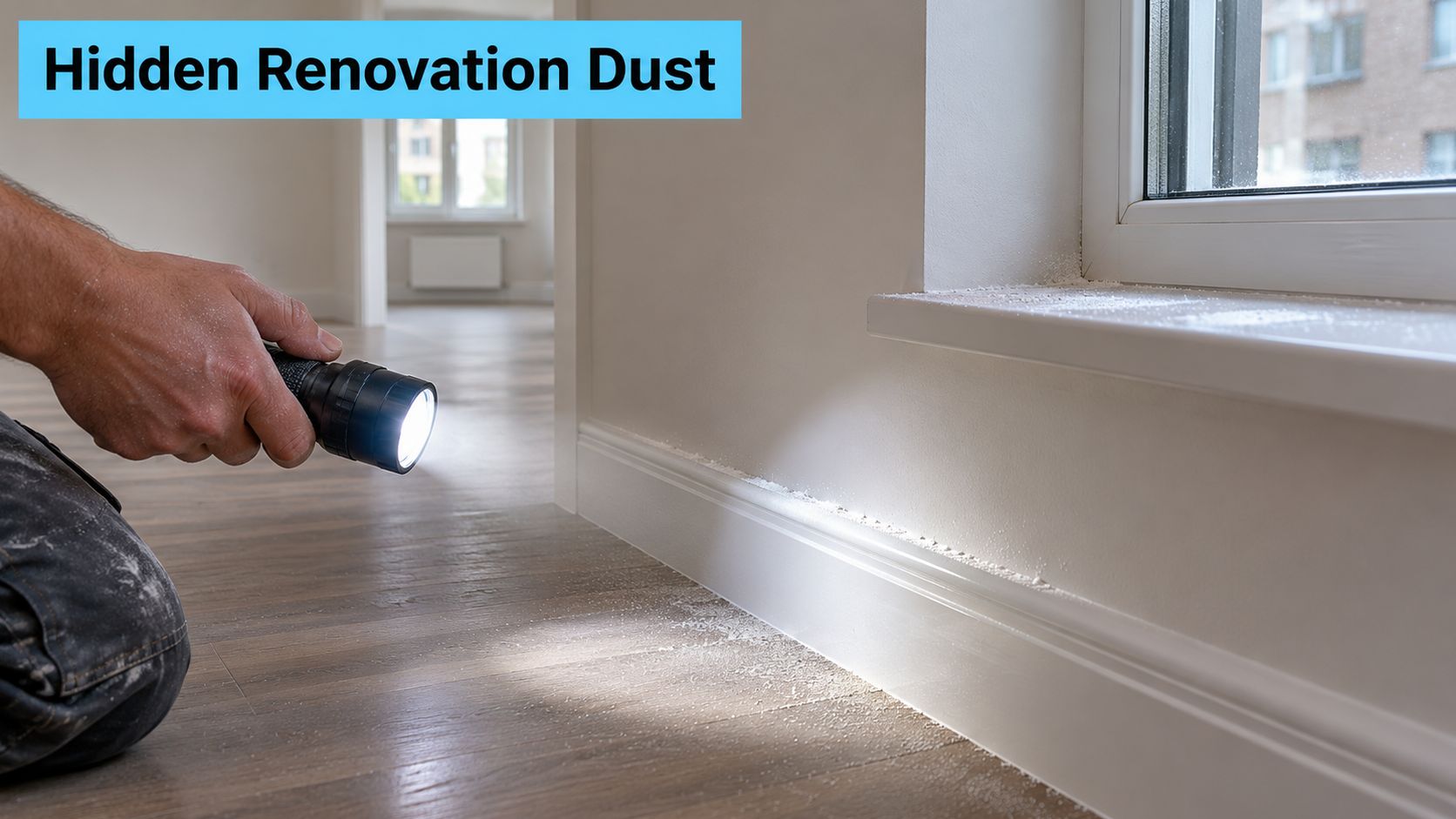
A standard turnover wipes what you can see. Renovation residue is smaller than that, and a cosmetic reset doesn't catch it.
What the dust actually is
Recent occupational-hygiene research in the Annals of Work Exposures and Health found that limited ventilation during indoor demolition and renovation let smaller particles accumulate, including respirable crystalline silica, with measured particle sizes around 1.2 micrometres. Construction-related indoor pollution can also include particulate matter, volatile chemicals, and fungal spores. Most move-in checklists never separate ordinary tenant turnover from that kind of contamination.
Questions to answer before anyone quotes
Ask these before you accept a standard move-in price.
- What work happened? Sanding, drywall, cutting, new flooring, painting, or HVAC running during the work all change the clean.
- How long ago did it stop? Dust that is still settling needs a later final wipe than dust that has already come down.
- Did the system run? If the HVAC was on during cutting or sanding, the filter and the returns are part of the job.
Controls a standard clean doesn't include
The rest of the sequence matches a normal top-to-bottom clean. Renovation adds four controls.
1. HEPA-vacuum before any wet work, so loose dust isn't turned into paste.
2. Replace the HVAC filter so the system doesn't blow captured dust back out.
3. Run ventilation during the clean and after it, rather than sealing the unit up.
4. Delay the final wipe until settled dust has been removed, then wipe again.
Our post-construction service starts at $508 in Fall River and is booked as its own package, with its own scope. Prices for that package are laid out in our post-construction cleaning prices guide. It isn't a move-in clean with a different name.
Cleaning doesn't replace a professional asbestos, lead, mold, or silica assessment. Older buildings, or any material you suspect, should be assessed before a crew disturbs it.
How a Move-In Clean Runs From Top to Bottom
A move-in clean works like repainting a wall: prep comes first, the finish coat comes last, and any dust trapped between layers shows through. Treat the visit as controlled soil removal, where each step protects the one after it.
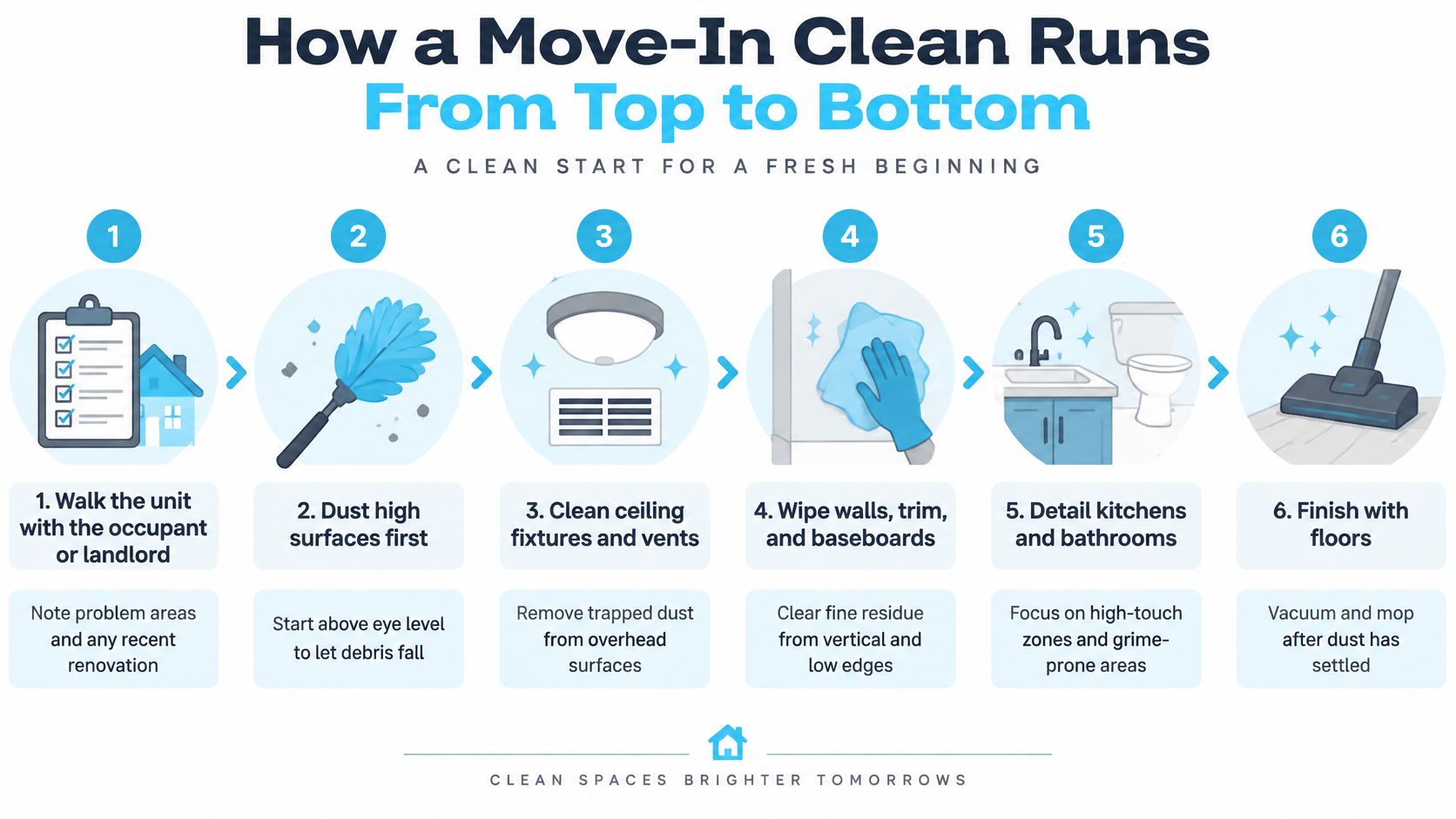
1. Walk the unit with the occupant or landlord. Note grease, limescale, odors, and any recent renovation so the scope matches the rooms, not the listing.
2. Dust high surfaces first. Ceiling fans, vents, light fixtures, and the tops of cabinets get damp cloths. The U.S. Environmental Protection Agency recommends damp dusting because moisture keeps settled particles from becoming airborne, and a HEPA-filter vacuum so dust doesn't blow back out the exhaust.
3. HEPA-vacuum loose dust and debris. Use a crevice tool along edges, vents, and baseboards. This first pass takes the bulk particulate before anyone wets a surface.
4. Wet-clean with detergent. Kitchens, bathrooms, cabinet fronts, switch plates, and door frames come next. Wet cleaning catches fine residue that a dry wipe would only move around.
5. Disinfect the high-touch points you already listed, and keep each surface visibly wet for the label contact time. Cutting that wait short leaves the step unfinished.
6. Clean floors last. Mop hard floors only after the overhead work, then vacuum carpet. Dust from fans and vents lands on whatever you finished too early.
7. Make a final HEPA pass after surfaces dry. Then check the unit against the checklist and photograph each room.
For dusty rooms after a vacancy, remodeling, or work around baseboards and vents, a three-pass sequence works well: HEPA-vacuum, wet-clean with detergent, then vacuum again after drying. The middle pass grabs what dry wiping redistributes. The last pass picks up what the first two stages knocked loose.
People with asthma or allergies should leave the area while it is being vacuumed. Stirred-up dust is the exposure, even when the vacuum has a HEPA filter.
The check that closes the job
Walk each room with the lights on. Open a cabinet, look along the baseboard, and check the bath fixtures before you sign off. A photo of each room, taken after the final vacuum, is what you compare if a spot is disputed later. If you want the heavier reset that reaches behind furniture on a home that isn't a turnover, our deep cleaning service is the matching visit.
Confirm Your Scope and Book the Move-In Clean
A move-in clean is priced as a turnover: an empty unit, a defined set of add-ons, and a date that falls after the last occupant leaves. Two quotes can both read "move-in clean" while covering different jobs, so confirm the scope in writing before you compare numbers.
- Size: Square footage and bathroom count, written on the quote. With your add-ons, they set the flat rate.
- Contents: Say whether the unit is empty or still furnished. Furnished rooms take longer.
- Add-ons: Name oven and refrigerator interiors and interior windows if you want them. Anything not listed is not included.
- Recent work: Note any renovation since the last occupant. Construction dust routes the job to post-construction cleaning, which starts at $508 in Fall River rather than the $480 move-in rate.
- The date: It should fall after move-out, with water, power, and keys or codes ready.
Ask whether the quote includes disinfection of high-touch points, then set that quote next to any other you're comparing, using the same square footage, bathroom count, and add-ons. If one quote is missing a line, it isn't the cheaper version of the same job. You can skip negotiating supplies entirely, since the crew brings commercial-grade vacuums, fresh microfiber mop heads, and sanitizing products.
With those details in, the instant quote tool shows the exact flat-rate price before booking, with no surprise fees or hidden surcharges. Prefer to talk the scope through? Call (508) 296-6633.
Book once the quote matches the scope, the timing, and any renovation needs. If the unit gains furniture, loses power, or picks up construction work before the crew arrives, reschedule. A price set for an empty apartment won't hold for a dusty renovation or a house that is still full.
---
Glow Cleaning Company handles move-in and move-out cleaning as a scoped turnover, with a separate post-construction clean when renovation dust is part of the job, across Massachusetts and Rhode Island. If you're about to take keys or turn a unit, match your rooms, add-ons, and timing to a flat-rate quote before the truck arrives. Visit Glow Cleaning Company to check your address and see the price before you book.