A deep clean at Glow Cleaning Company starts at $425 as a flat rate in Fall River, MA, with eligibility checked by address across parts of Massachusetts and Rhode Island. Published national averages for a typical deep clean sit well below that figure, and the gap says less about one company's rates than about how loosely the deep-clean label gets applied from one quote to the next.
Two quotes for identical square footage can still differ by hundreds of dollars, because the price is built on the labor a specific home needs rather than on floor area. Grease that takes three passes, pet hair packed behind a refrigerator, grout in a second bathroom: all of it converts into hours, and hours convert into the number on the invoice. Square footage decides where pricing starts; condition decides where it ends.
That makes a deep clean a scope and risk decision rather than a room-size price. The useful question is which quote covers the work your home needs, and what a lower number leaves behind when it doesn't.
What a Deep Clean Typically Costs in 2026
A typical deep clean in the U.S. runs about $189 to $331, and Thumbtack's national deep cleaning cost data reports a low-end average of $127 with high-end examples reaching about $502. That is close to a fourfold spread between the cheapest and most expensive jobs the same category produces.
| Benchmark | Price or figure | Source context |
|---|---|---|
| Typical national deep-clean job | $189 to $331 | Thumbtack national pricing data |
| Reported low-end national average | $127 | Thumbtack national pricing data |
| High-end national examples | about $502 | Thumbtack national pricing data |
| Glow Cleaning Company deep clean, Fall River | starts at $425 | Company flat-rate pricing |
| Glow Cleaning Company general cleaning | starts at $150 | Company flat-rate pricing |
The spread exists because "deep clean" describes a category, not a fixed task list. A job priced near $127 and one priced near $502 can carry the same label while covering very different work. The detail tasks are what separate them: baseboards, vents, areas behind furniture, and the buildup a routine visit leaves untouched. When two quotes on the same home land far apart, the lower number almost always reflects a shorter list rather than a cheaper rate for identical work.
Glow Cleaning Company prices its deep clean as a flat rate starting at $425 in Fall River, with the exact figure set by square footage, bedroom and bathroom count, and any add-ons selected before booking. The quote tool shows that number upfront, with no surprise fees added afterward. Homes that only need floors, bathrooms, kitchens and visible surfaces fit a narrower scope, and the company's general cleaning service starts at $150 for that work.
Two quick reads follow. A quote well under $189 for a full home is almost certainly priced without the detail tasks, which makes it a maintenance visit sold under a deeper name. A quote inside or above the national band earns that position only if the checklist names the baseboards, vents and behind-furniture work those extra dollars are meant to buy.
Why Labor Hours Set the Deep Cleaning Price
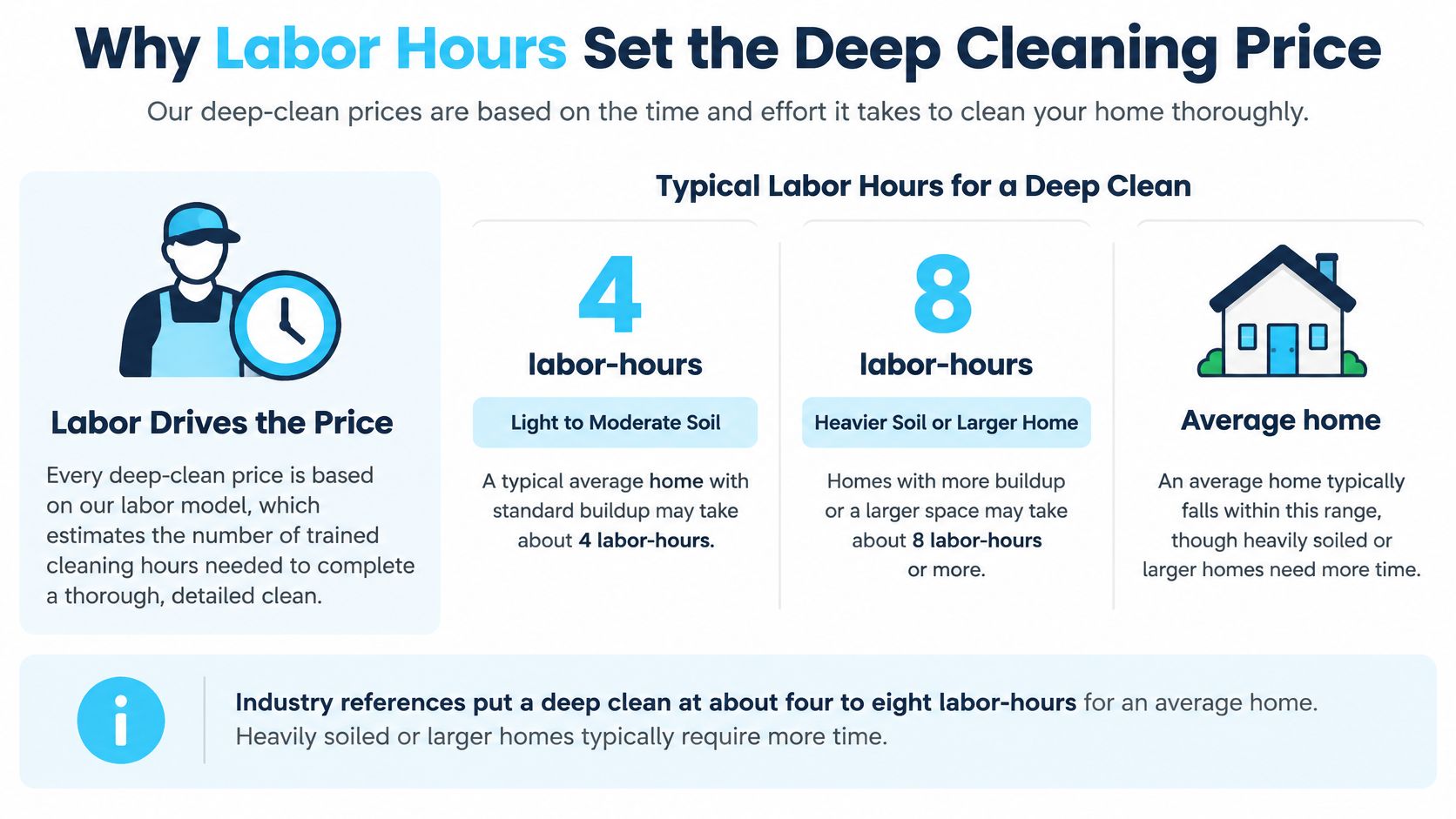
Industry pricing references describe a deep clean as requiring roughly four to eight labor hours for an average home, with heavily soiled or larger properties needing multiple cleaners or a full working day (Estimatty's deep cleaning cost guide). Labor-hours are the unit of production here. Everything else in the quote is a conversion of those hours into dollars.
Two Cleaners, Eight Hours, Sixteen Labor-Hours
The arithmetic is where most homeowners lose the thread. A four-hour visit staffed by two cleaners represents eight labor-hours. An eight-hour job with two cleaners represents 16 labor-hours before overhead is counted at all. Clock time on your calendar and billable labor are different quantities, and crews are scheduled by the second one.
The Wage Is Not the Invoice
The median hourly wage for janitors and building cleaners sits far below the hourly rate a cleaning company bills, and the gap is structural rather than markup for its own sake. A company invoice has to support payroll taxes, workers' compensation, bonding and insurance, transportation, equipment, supplies, administrative and scheduling labor, and the margin that keeps the business running.
Once those inputs are stacked, each billed hour costs a multiple of the employee's pay. Regional costs, company overhead and specialized work push that loaded figure higher still, which is why two companies paying similar wages can quote very different flat rates. The quote you see reflects the cost structure behind the hour, and the risk allowance a company builds in for the conditions it expects to find.
The check worth running: divide the flat rate by the labor-hours a company quotes you. If the result lands far below what a staffed hour costs to run, the cut happened in scope rather than in rate.
The gap between a deep clean and a recurring maintenance visit on the same home is mostly a difference in labor-hours, not a different hourly rate. That's why comparing an invoice against a cleaner's wage never produces a useful answer.
Cost Factors That Move a Deep Clean Quote
Neutral U.S. market benchmarks place deep-clean projects broadly around $175 to $600, and the spread across that band tracks whether the work includes baseboards, grout, accumulated soil, appliance interiors and move-out-level detailing (house cleaning cost benchmarks). The estimating model behind a professional quote is productive labor hours multiplied by loaded hourly cost, plus consumables and equipment, travel and overhead, and a scope-risk allowance for the surprises a home holds.
What Changes the Hours
| Factor | How it changes the labor | Effect on the quote |
|---|---|---|
| Square footage and bedroom count | Sets the base labor hours | Largest driver of the flat rate |
| Bathroom count | Each bath needs its own grout, fixture and floor pass | Adds time per room |
| Soil level and buildup | Heavy grease or grime needs extra passes and products | May push the job to multiple cleaners or a full day |
| Appliance interiors | Oven and refrigerator interiors are separate tasks | Priced as optional add-ons |
| Clutter and furniture | Moving items slows cleaning behind and under them | Extra hours for each area |
| Post-renovation residue | Dust and debris need extra vacuum and wipe passes | Post-construction service starts at $508 |
Bathroom count surprises people most. Every bathroom carries its own grout line, fixtures, floor and glass, so a second or third bath adds a full pass rather than a few minutes. Furniture behaves the same way: a home crowded with chairs, rugs and consoles takes longer to clean behind and under, and every item moved shows up as time on the labor line.
Soil level is the wildcard. Heavy kitchen grease, pet hair in soft furnishings or years of buildup on baseboards can demand extra passes and stronger products, and condition is the factor most likely to turn a single cleaner into a crew or a full working day. Post-renovation dust belongs in its own category, because fine residue settles on every horizontal surface and re-suspends each time it's disturbed.
Oven interiors and refrigerator interiors are separate tasks with separate time, and they're priced as optional add-ons rather than folded into a base rate. Published benchmarks don't itemize those add-on prices, which is exactly why the add-on figure belongs to your specific quote and not to a national average.
The exact flat rate for a deep clean depends on square footage, bedroom and bathroom count, and any optional add-ons selected before booking. Our checklist details are customized to each home's needs rather than applied as a fixed template.
Practical rule: A price quoted without asking for the bathroom count is a placeholder, not an estimate.
Why the Cheapest Deep Clean Quote Costs More
The lowest advertised number is often the most expensive way to buy the work, and the reason isn't an upsell. It's definition. A recent dataset reported median totals of $535 for deep cleans, $551 for move-in/move-out cleans and $614 for post-construction cleans, totals that sit well above headline national ranges because they describe jobs that were fully scoped (JM Cleaning Team's house cleaning cost analysis).
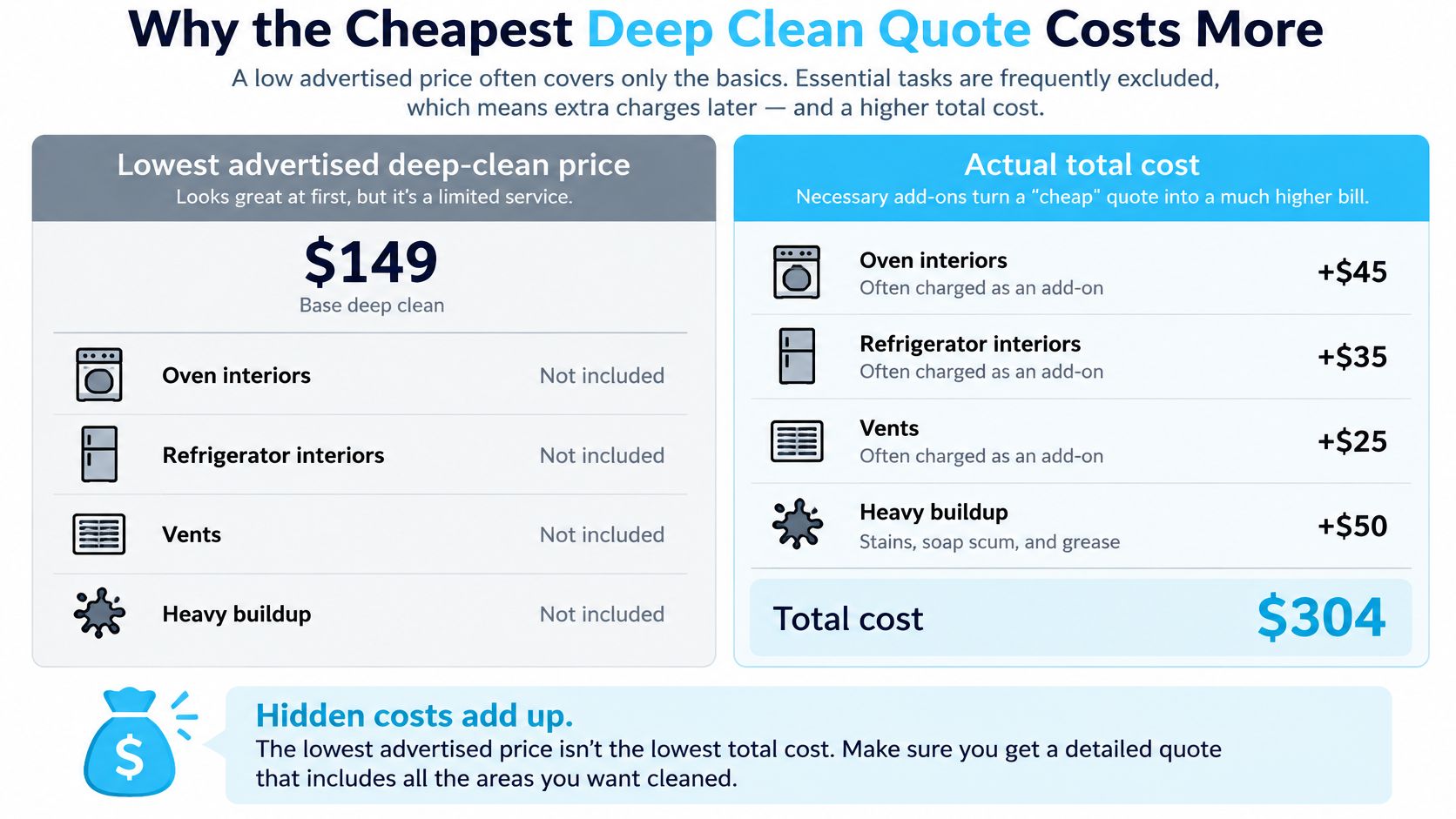
A narrowly written service can leave oven interiors, refrigerator interiors, vents or heavy buildup outside the quote. Each exclusion becomes a second booking and a second bill, and the homeowner ends up paying twice for one job that should have been priced once.
A cheap deep clean isn't a discount on the same work. It's a smaller definition of the work.
Here's how that plays out in practice, including where the break-even falls between one intensive reset and ongoing upkeep.
The Break-Even Between a Reset and a Routine
| Service | Frequency | Starting price | Best for |
|---|---|---|---|
| Deep clean | Once | $425 flat rate | Homes with built-up grime and neglected areas |
| Weekly recurring | Every week | $90 per visit | Busy homes needing constant upkeep |
| Biweekly recurring | Every two weeks | $135 per visit | Homes already reset that need steady maintenance |
| Monthly recurring | Every four weeks | $210 per visit | Light upkeep between deeper cleans |
Run the numbers on a home that's already reasonably clean. Three biweekly visits at weeks 0, 2 and 4 cost $405, just under a single $425 deep clean. For that household, recurring visits deliver more total cleaning for less money.
The comparison breaks down on a home with grease film on the cabinets and a decade of dust on the baseboards. Recurring visits are built for routine upkeep once deep buildup has been removed, so a maintenance crew working on an unrestored house never catches up. The two services answer different conditions rather than competing for the same job, and the order matters more than the price.
How to Test a Cheap Quote
Ask whether the quote names the rooms and tasks you care about: baseboards, vents, inside the oven, inside the refrigerator, behind the furniture. Then ask whether the items it excludes carry their own price. If the answer to either is vague, you're not looking at a bargain, you're looking at an unfinished estimate that will finish itself later.
Move-Out Cleaning Cost and Deposit Risk
Glow Cleaning Company's move in and move out cleaning starts at $480, and the figure a tenant should weigh against it isn't square footage. It's the deposit.
Cleaning was the leading reason for tenancy-deposit claims for five consecutive years, rising from 24.57% of claims in 2021 to 29.38% in 2025, according to UK Deposit Protection Service figures. Those percentages describe UK tenancies, so read them as a pattern rather than a U.S. benchmark. The pattern travels well: end-of-tenancy cleaning is the most contested line item on the ledger, and it's the one a tenant can control in advance.
The distinction that decides most disputes is ordinary wear versus chargeable cleaning. Worn carpet, faded paint and scuffed baseboards are the landlord's cost of ownership. Grease on a range hood, soap film on glass, hair in a drain trap and rubbish left behind are cleaning, and they're chargeable when the lease sets a standard of cleanliness at handover.
For tenants: the lease sets the cleanliness standard, not the landlord's preference. Read what it actually requires before you decide how much cleaning to buy.
Build the evidence file as you go:
- Photograph before and after. Kitchens, bathrooms, floors, appliances, and any pre-existing damage.
- Record meter readings on the same day as the handover so the timeline is unambiguous.
- Compare against the move-in inventory instead of against memory.
- Confirm the inclusions. Inside appliances, interior windows, walls and rubbish removal sit outside many quotes.
- Keep the paperwork. An itemized receipt or written scope document is the evidence that survives a dispute.
Paying more for a documented, correctly scoped clean can be the rational choice when a deposit or a lease deadline is at stake. Paying for an oversized deep clean is unnecessary when the agreement asks only for the property's original standard of cleanliness.
Confirm the Scope Before You Book a Deep Clean
The last check happens before money changes hands, and it takes about as long as reading a quote line by line.
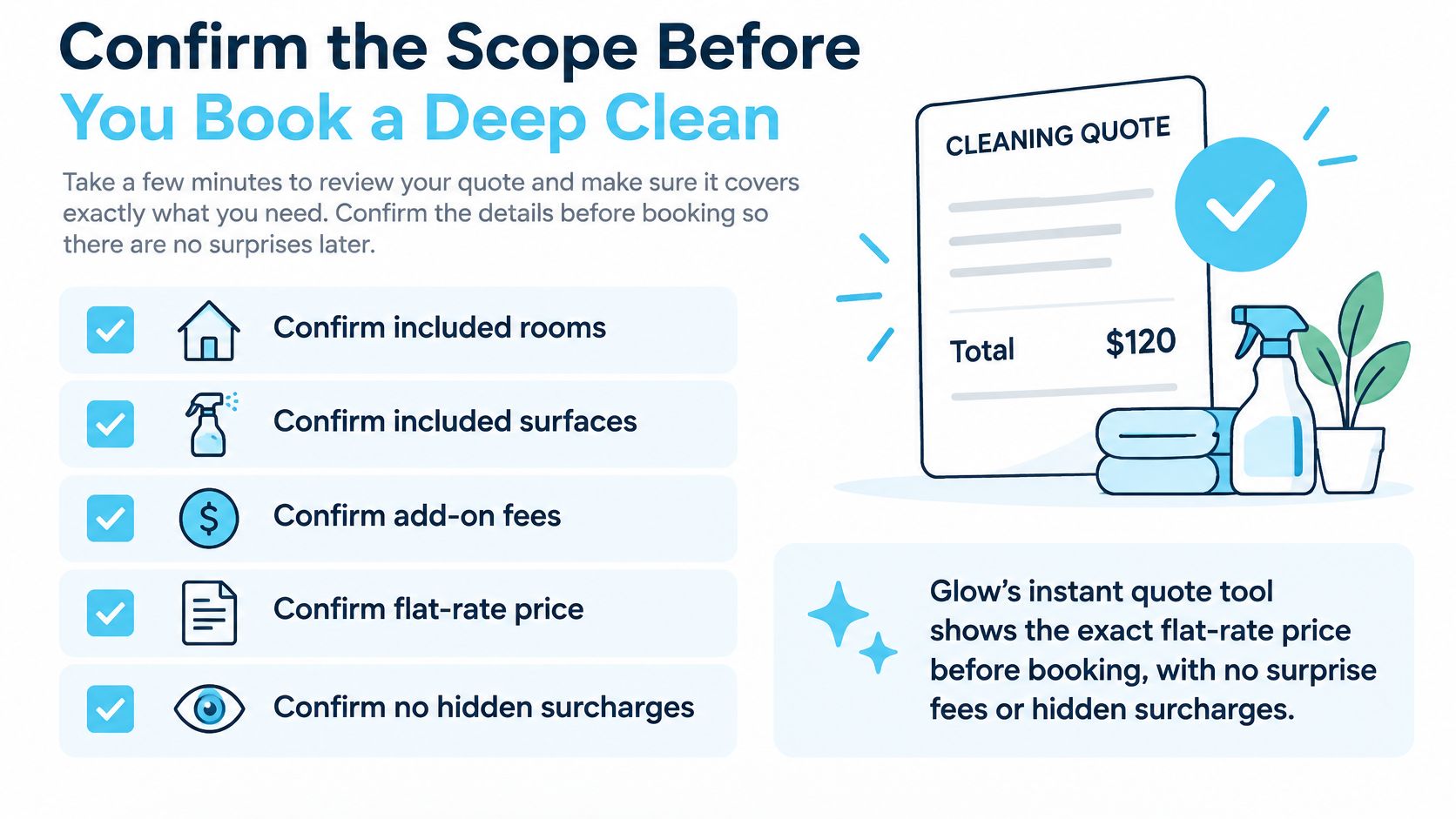
1. Measure the property. Square footage, bedroom count and bathroom count set the base labor.
2. List the problem areas. Kitchen grease, pet hair, buildup behind furniture, and any moisture you've noticed.
3. Select your add-ons. Oven interior, refrigerator interior, interior windows and baseboard detailing are priced separately from the base service.
4. Confirm the included rooms and the expected hours so the flat rate has a visible labor assumption behind it.
5. Compare the quote against your list from step two. Any item missing from the scope should either be removed from your expectations or added to the price.
6. Choose one-time or recurring. The reset first if the home has built-up dirt, the recurring plan if it's already maintained.
Our instant quote tool shows the exact flat-rate price before booking, and pricing carries no surprise fees or hidden surcharges, so the figure shown is the figure paid. Fall River, Taunton, Attleboro, New Bedford, Dartmouth and the surrounding communities are all covered, and you can review the plans and inclusions on the cleaning packages page before you commit.
One boundary is worth stating plainly. Mold remediation and hazardous contamination are specialist scopes, not ordinary deep cleaning. The EPA's indoor air quality guidance notes that cleaning can reduce but not eliminate dust mites, pollen and animal dander, and that vacuuming can temporarily raise airborne allergens, which is why a well-sequenced visit handles high-dust work first and finishes with damp wiping. Ventilation and a dry, leak-free property do the rest, and a genuine mold problem needs a different trade.
Book a deep clean now if the home has accumulated dirt behind furniture, on baseboards and around vents. Move to recurring visits once that buildup is gone and the job becomes upkeep.
---
Glow Cleaning Company handles deep cleaning from $425 flat rate across Fall River, Taunton, Attleboro, New Bedford, Dartmouth and the surrounding Massachusetts and Rhode Island communities, with the exact price confirmed in the instant quote tool before you book. If your home has built-up grime in the corners and behind the furniture, start with the reset, then hold it with weekly, biweekly or monthly visits. Visit Glow Cleaning Company to build your quote and pick a date.