A spotless refrigerator can still be the riskiest appliance in the kitchen. By 2005, a domestic refrigerator was present in 99.5% of American homes, according to the U.S. Department of Energy's refrigeration timeline, which means almost every household runs a cold box full of food on a machine nobody inspects. Many people book a refrigerator cleaning service because of a smell. The smell is a symptom, not the problem. The actual work is removing the residue that feeds bacteria, checking that the appliance still holds a safe temperature, and knowing which messes a cleaner can fix and which ones need a technician.
That distinction changes how you buy the service. A wipe-down of the front and handles is kitchen maintenance. Opening the doors, pulling the shelves, washing the gasket and documenting what came out is food-safety work, and it's priced and scheduled differently.
What a Refrigerator Cleaning Service Covers
Start with a scenario. A family books a standard kitchen clean before a dinner party. The cleaner wipes the fridge front, the handles, the sides, and the top of the door. Twenty minutes, done, and the kitchen looks right. Two weeks later the same family opens the crisper drawer and finds slime under the produce bag. Nothing was wrong with the first visit. It just wasn't the same job.
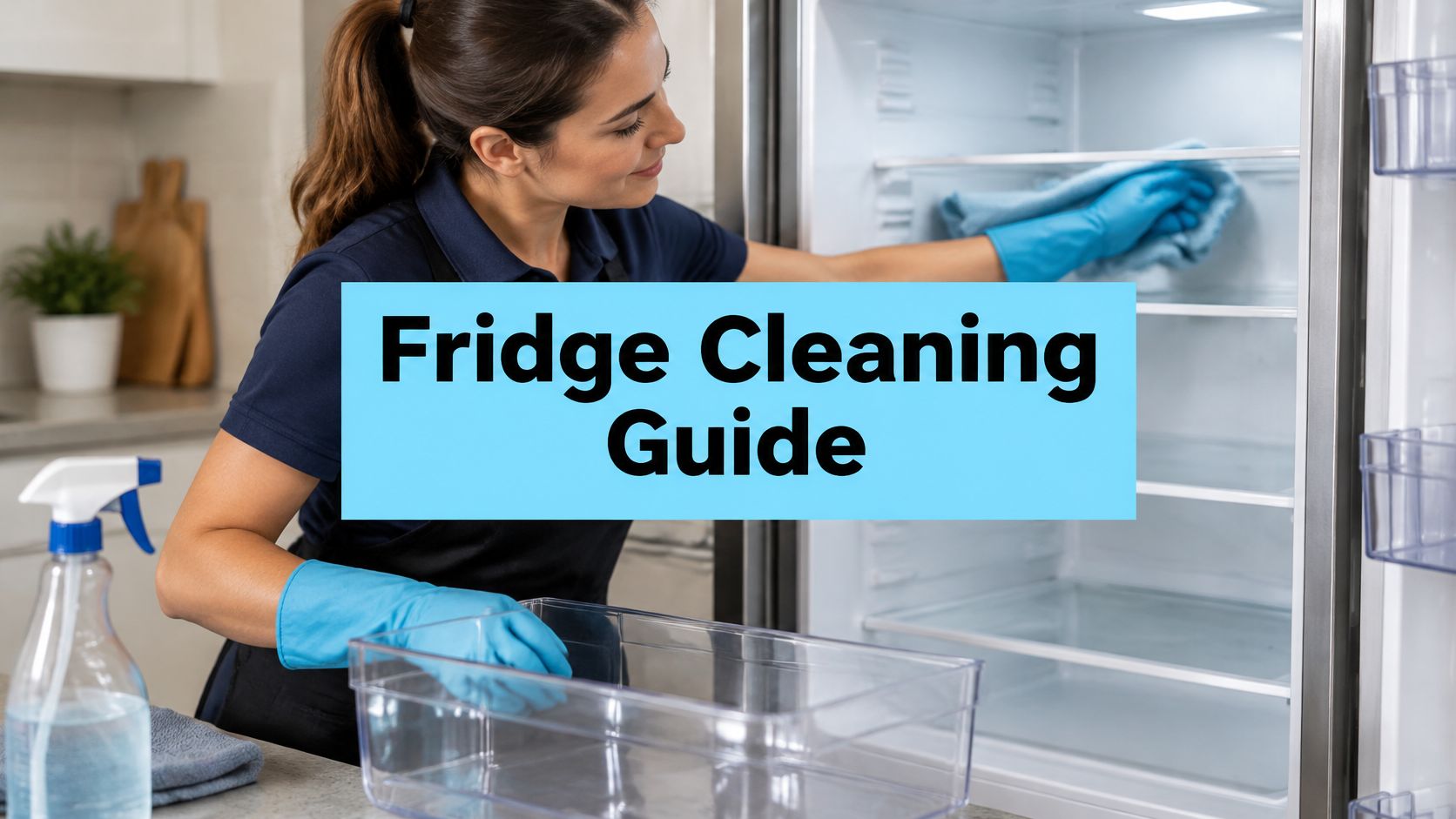
A refrigerator cleaning service is the second job. The appliance gets emptied, shelves and drawers come out and get washed by hand, the door bins get cleared of expired jars, the rubber gasket gets wiped through its folds, and the vent grille gets vacuumed so air can move across the condenser. The analogy that resonates is dusting versus a full kitchen reset. Dusting touches what you can see. The reset moves things, cleans underneath, and puts them back.
At Glow Cleaning Company, recurring visits wipe the exterior of kitchen appliances, including the fridge front and handles, as part of routine work. Interior refrigerator cleaning is added to the booking checklist, which is where the deep work gets scheduled and priced.
| Area | Typical task | Why it matters |
|---|---|---|
| Shelves and glass panels | Remove, wash by hand in hot soapy water, dry | Spills seep into seams and under glass |
| Crisper and sliding drawers | Empty, wash, sanitize | Vegetable drawers collect residue and moisture |
| Door bins and ledges | Clear expired items, wash, wipe | Sticky spills collect on bin ledges |
| Door gasket | Wipe the folds and check for mold | Rubber casings trap grime and cause musty odor |
| Interior walls and ceiling | Wipe with a food-safe cleaner | Drips and residue build up over time |
| Exterior and handles | Wipe doors, handles and sides | Fingerprints and grease show on kitchen fronts |
| Vents and grille | Vacuum accessible dust | Dust reduces airflow around the cabinet |
Practical rule: if the quote doesn't mention the gasket, the drawers and the vent grille, you're buying an exterior detail, not an interior clean.
Three signs tell you an interior clean is due now rather than later. Visible spills that have dried into a shelf seam, because residue that stays wet feeds growth. A lingering odor that a baking soda box and a wipe don't shift, because the source is usually a drawer, a gasket fold or the drip area. And a move-in or move-out date, when the appliance has to be handed over in a condition the next occupant can inspect.
Prices, Timing and Recurring Plans
A refrigerator clean is an add-on priced at checkout, not a mystery line on the final invoice. Glow Cleaning Company prices flat-rate with no surprise fees or hidden surcharges, so the number the instant quote tool shows is the number you pay. That matters more with refrigerator work than with most tasks, because the labor varies so much from one kitchen to the next.
| Option | Starting price | What to know |
|---|---|---|
| Refrigerator add-on to a booking | Flat rate shown at checkout | Quoted at booking and added to the checklist |
| Deep Cleaning, whole home | $425 | Most popular one-time service; add the fridge to the checklist |
| Weekly recurring visit | $90 per visit | Includes wiping kitchen appliance exteriors |
| Biweekly recurring visit | $135 per visit | Interior fridge work is an add-on, not standard |
| Monthly recurring visit | $210 per visit | Light upkeep between deeper cleans |
| Independent hourly benchmark (KLY Cleaning) | $55 per hour per cleaner | Most refrigerators need 1–2 hours of work |
To sanity-check any quote, use the hourly benchmark. A 2025 U.S. refrigerator-cleaning listing from KLY Cleaning charges $55 per hour per cleaner and reports that most refrigerators require 1–2 hours of work. One cleaner for that window lands between $55 and $110. A whole-home quote includes a team and more rooms, so compare like with like instead of holding a single-appliance price against a full-property price.
What moves the number
Size is the first factor: a compact under-counter unit and a four-door French-door model aren't the same job. The count of drawers and shelves matters too, because every removable part gets washed separately and dried before it goes back. Heavy buildup costs more than light upkeep, sanitizing is a separate step with its own product and dwell time, and a deep clean costs more than a refresh.
Ask one question before you book: does the quote cover shelves, drawers and the gasket? Scope varies widely between providers, and the gasket is the item most often left out.
Setting the interval
A full interior clean roughly every three months, with exterior wiping between visits, is a workable default for a busy household. It sits close to what people do. A 2024 YouGov survey across 17 markets found that 26% of respondents clean their refrigerators every few months, as reported by YouGov.
Shorten the interval after a raw-meat leak, a spill that soaked into a drawer, a musty smell that comes back within days, or a move date. Set the schedule from the last clean and the current refrigerator temperature, not the calendar alone. If you're comparing this against the rest of a house reset, the deep cleaning cost breakdown shows where appliance interiors sit against room-by-room work.
How a Food-Safe Refrigerator Clean Works
Cleaning a refrigerator is a food-safety control, not an appearance task. That framing sets the order of the steps, and the order is what separates a professional clean from a fast wipe.
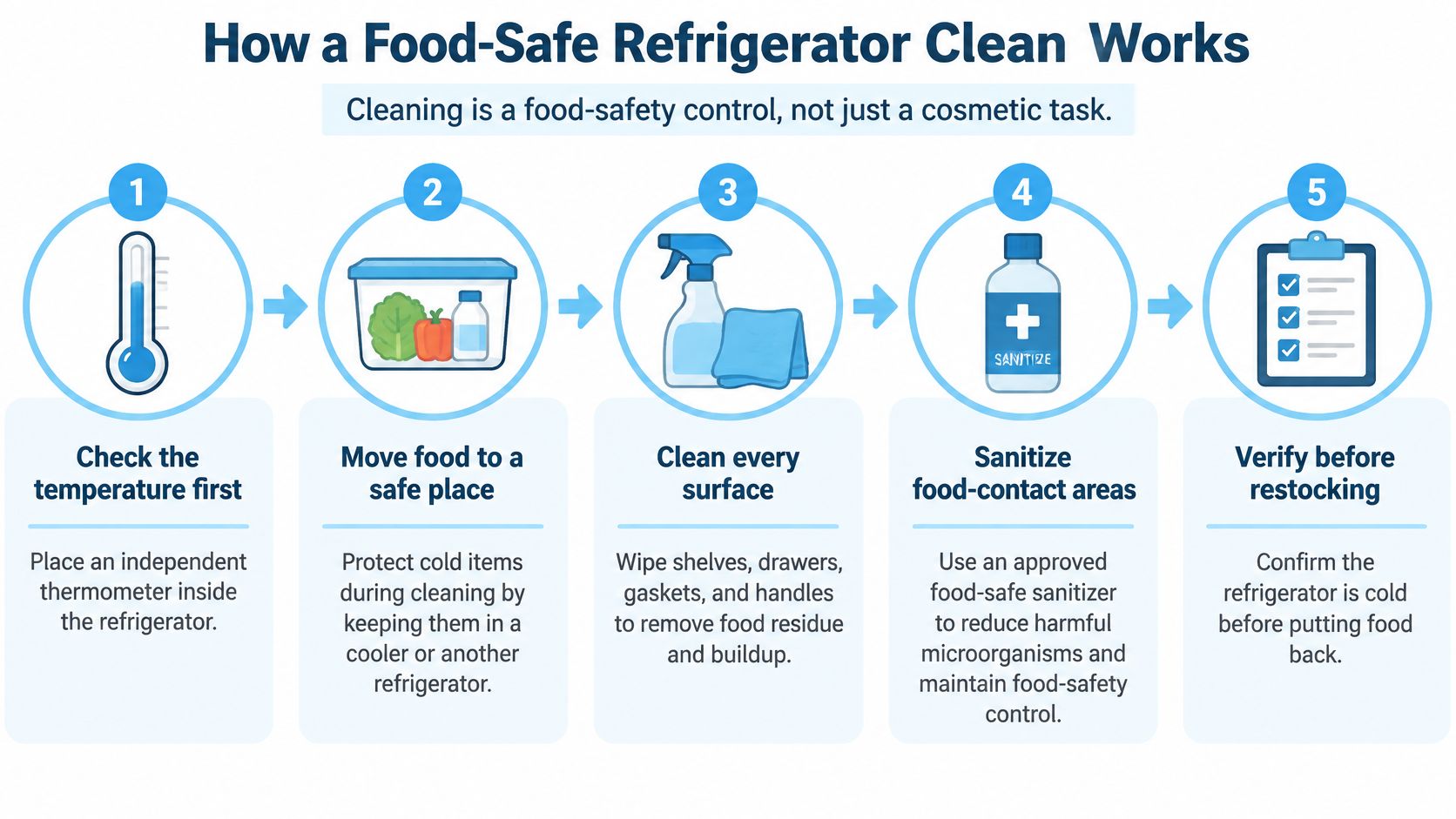
1. Check the temperature first. Place an independent appliance thermometer inside and confirm 40°F (4°C) or below, because a control dial may not display the actual internal temperature. That threshold slows pathogens such as Listeria rather than stopping them, which is why the reading gets recorded before anything else happens, per the FDA guidance on preventing Listeria.
2. Move food to a safe place. Anything questionable or recalled comes out first, and perishables stay out of refrigeration for no more than two hours.
3. Empty and sort the shelves and drawers. Removable parts are stacked separately, and glass goes in its own pile so nothing heavy lands on it.
4. Let cold glass reach room temperature. Hot water on a cold glass shelf can crack it through thermal shock, so the glass waits while the rest of the job starts.
5. Wash removable parts by hand in hot, soapy water, then wash the fixed interior walls, ceiling and floor the same way. Hand washing beats the dishwasher for coated and glass parts.
6. Rinse and dry thoroughly. Residual soap film attracts dust and leaves streaks, and trapped moisture is what mold needs.
7. Sanitize where the risk warrants it. Sanitizing is a separate step that follows soap-and-water cleaning, applied per the label directions, and products are never mixed.
8. Document and control cross-contamination. Visible spills, raw-meat leakage, damaged seals and the post-clean temperature get recorded, and microfiber cloths are fresh or segregated by zone.
Glow Cleaning Company brings its own HEPA vacuums, fresh microfiber cloths, and family-safe eco cleaners to every cleaning, so you don't need to assemble supplies or leave bottles out for the crew.
These controls matter most in households with children, older adults, pregnant people or anyone immunocompromised, where a lapse in cold storage carries more risk. The same sequencing logic applies to the rest of the kitchen, which is why removing stove grease follows a similar dwell-then-wipe discipline rather than a spray-and-rub approach.
Here is the walkthrough of the sequence in motion:
A finished job has three markers: surfaces are dry to the touch, there's no sour smell when you open the door, and the thermometer reads 40°F or below before food goes back in.
Dry, cold and odor-free, in that order. If any one of the three is missing, the job isn't finished.
Discard or Keep After a Recall, Spill or Leak
The first decision after a recall or a leak isn't how to clean. It's what goes in the bin. Cleaning does not make contaminated food safe, so a recalled product is discarded exactly as the recall notice directs, then the interior is cleaned.
Temperature settles most of the remaining calls. The USDA's Food Safety and Inspection Service identifies 40°F to 140°F as the "Danger Zone," where bacteria can multiply rapidly, with some doubling in number in as little as 20 minutes, and it advises discarding perishable food held above 40°F for more than two hours, per the FSIS refrigeration guidance.
| Situation | Action | Basis |
|---|---|---|
| Recalled product | Discard as the recall notice directs | Recall notice |
| Perishable food held above 40°F for over two hours | Discard | FSIS guidance |
| Raw-meat leak onto other food | Discard the food the leak touched | Wash the drawer, then sanitize |
| Sealed food untouched by a leak, fridge at 40°F or below | Keep and restock after the clean | Independent thermometer check |
Once the food decisions are made, the cleaner's part follows a set order. The interior is cleared, shelves and drawers are washed separately in hot soapy water, surfaces are sanitized afterward, and containers and hands are washed before anything goes back, following the CDC clean-refrigerator steps.
Two details get skipped in a hurry. Porous or visibly contaminated items, like an unwrapped block of cheese next to a leak, are a disposal call rather than a rinse-and-keep call. And the technician records visible spills, raw-meat leakage, damaged seals and the post-clean temperature, which gives the household a written account of what was done and what was found. Before restocking anything you kept, confirm the temperature with an independent thermometer rather than trusting the dial.
When Cleaning Cannot Fix the Problem
A clean refrigerator is not automatically a safe one. A study of 100 domestic refrigerators in Japan tested microbial contamination across the egg compartment, bottom shelf and vegetable drawer and concluded that refrigerator hygiene is relevant to food-poisoning prevention, published in PubMed. Visible cleanliness is not microbiological cleanliness.
That is the honest boundary of the service. A cleaner removes accessible residue, biofilm and surface mold. A cleaner cannot repair an appliance that runs warm, remediate contamination inside the insulation, or fix a seal that no longer closes.
Where the line sits: cleaning handles what you can reach and see. Repairs handle what the machine is doing wrong.
The three questions worth answering plainly
Will cleaning remove mold permanently? It removes what is on the surface. Mold returns when moisture keeps returning, and on a refrigerator the usual moisture source is a gasket that no longer seals or a drain path that stays wet.
Should the gasket be replaced? If mold comes back in the folds after a clean, or the rubber is torn, stiff or visibly not meeting the frame, replacement is the fix. Rubber door casings and musty odors are the usual mold trouble spots, so periodic interior cleaning with targeted gasket treatment helps, but it is maintenance, not a cure for a failed seal.
When is a persistent odor a repair issue? When it survives a full clean and sanitize, or when it comes back within days. At that point the source is usually behind a panel, in the drain or in the insulation, and it needs an appliance technician.
Never mix bleach, vinegar or baking soda in an attempt to cover several problems at once. Sanitizing comes after soap-and-water cleaning, and it follows the label.
| Issue | Cleaning can address | Needs another professional |
|---|---|---|
| Food residue, spills and sticky shelves | Yes, with hot soapy washing and sanitizing | Not needed |
| Surface mold on the door gasket | Yes, for accessible surface mold | Replace the gasket if mold returns or the seal is damaged |
| Musty odor after cleaning | Partly, if the source is accessible | Appliance check if the odor returns |
| Concealed insulation contamination | No | Appliance technician |
| Running warmer than 40°F (4°C) | No, cleaning cannot correct temperature | Appliance technician |
| Recalled or spoiled food inside | Removal and cleaning of the interior | Discard food per the recall notice |
The practical trade-off is simple. A deep clean on a machine with a failed seal or a warm-running compressor buys you a few clean weeks, then the same mold and odor come back, and you have paid for a service that never had a chance of solving the problem. Sorting the machine fault first means the cleaning, when it happens, holds. A unit that cools properly and seals tight keeps a clean interior clean. A unit that does not will undo the work on its own schedule.
Book Your Refrigerator Cleaning Appointment
Booking takes a few minutes if you do the preparation in the right order. Each step below exists for a reason, and skipping one usually costs time on the day.
1. Get the exact price first. Run the address or postal code through the instant quote tool, which shows the exact flat-rate price before booking and confirms the property is inside the service area.
2. Add the refrigerator clean to the checklist. Note the size or model if the form asks, since a compact unit and a four-door model aren't scoped the same way.
3. Clear recalled and spoiled food before the crew arrives. Discard it according to the recall notice, because cleaning doesn't substitute for throwing contaminated food away.
4. Flag fragile glass shelves. Point them out in the booking notes so they're handled separately and given time to reach room temperature before washing.
5. Disclose leaks, mold, raw-meat spills and warm running. Also state whether you want sanitizing, so the right products come in the van.
6. Pick a date and time window, and keep the doors closed until the clean starts. Every opening lets cold air out and pushes the interior temperature up.
7. Check the work afterward. Confirm the temperature with a thermometer, look over the gasket and shelves, and raise anything that's off while the satisfaction guarantee still applies.
When to book, and when to call a technician
Book the add-on when the refrigerator shows visible buildup, a returning odor, a spill that reached a drawer, an upcoming move date, or a recall that touched the shelves. Call an appliance technician instead when the unit runs warm, when the gasket is torn, or when an odor survives a full clean and sanitize. Recurring customers can fold the interior work into a standing weekly cleaning visit so the appliance never reaches the point where a single deep clean is a rescue job.
The two services aren't competitors. One keeps the interior safe to store food in. The other keeps the machine capable of holding temperature at all.
---
Glow Cleaning Company offers refrigerator deep cleans as an add-on to any booking, alongside one-time deep cleaning, move-in and move-out cleaning, and weekly, biweekly or monthly recurring visits across Fall River, Taunton, Attleboro, New Bedford and Dartmouth. The team arrives with its own HEPA vacuums, fresh microfiber and family-safe products, and the instant quote shows your flat-rate price before you commit. Visit Glow Cleaning Company to check availability by address and add a refrigerator clean to your checklist.